Sign up for e-mails about big Shameless news and events. We won’t give out or sell your address to anyone.
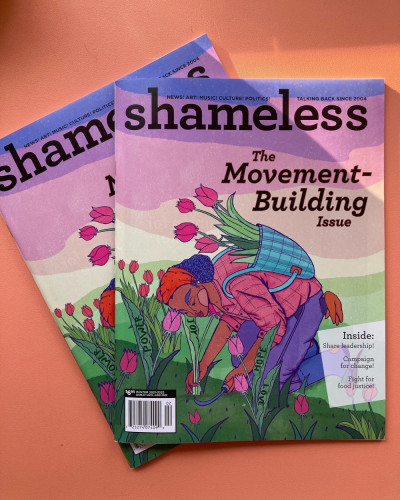
Shameless is an independent magazine with a very small budget. In addition to purchasing a subscription or back issues, you can support us through donations.
Friend, artist and big supporter of Shameless, Coco Riot, has been featured in Bitch magazine for their amazing art! We are so proud to work with you and to call you a friend, Coco!
A queer hispanic migrant artist, Coco Riot believes that art is not a tool for social change but social change itself. In their work Coco Riot loves exploring the multiple social possibilities of drawing and language through installation, animation film, print media, graphic novels, comics and in-site drawing exhibitions. The topics that fuel their inspiration range from queer politics, social and personal memories, living in different languages and the experience of migration, to Coco’s desire for bright colours and the love for poetry and repetitive patterns. In their work, Coco Riot uses personal experiences as metaphors to talk about social and political experiences experiences.
Shameless wants to put together a podcast of music by women, trans, genderqueer and non-binary folk that comes through non-mainstream channels, from parts of the world that often feel out of reach for those of us in Canada. Can you help us?
Send songs through sendspace.com or another online file sharing program to sfeldbloom@shamelessmag.com, and email some notes about the artist – where they come from, who they are, and what’s awesome about them and their music. How wonderful will it be to hear this playlist?! We’d love to get some of your title ideas too!
What a year! People say that every year as they bid the previous one adieu but 2011 has been full of world events that have shocked and touched us. Worry is one of the words that comes to mind when we think about 2011. From worry over the economy to fretting about our political climate, it’s clear the past year was fraught with events that, despite the fast pace of our lives, has caused us to pause and reflect. However, many events have given us lots of reason to hope and to be proud.
Here are just a few of the events and items of the past year that have caught the attention of some of your Shameless team members. We throw it to you to leave links, comments and discussion-starters in the comment section.
In keeping with the themes of the three print issues Shameless released this year, we offer you some jumping-off points:
–––-
Music in 2011
Wild Flag (self-titled album): One of Rolling Stone’s best albums of the year, including former members of Sleater Kinney, Mary Timony (ex-riot grrrl bands). [Co-founder Nicole Cohen says: “I am obsessed with this album; so so so good.”]
On a Mission, Katy B: A major breakthrough in the dubstep music genre, as it crossed over into pop consciousness. A UK release. [Web director Julia Horel can’t stop listening to it.]
What music did you love this year?
–––-
Politics in 2011:
The Northern Ontario Indigenous community of Attawapiskat declared a state of emergency in light of a housing and supply crisis … and no one came. Help has since been slow in coming and has been mostly inappropriate and inadequate. This is a humanitarian crisis, but it’s also political because it has occurred due to colonial governmentpolicies.
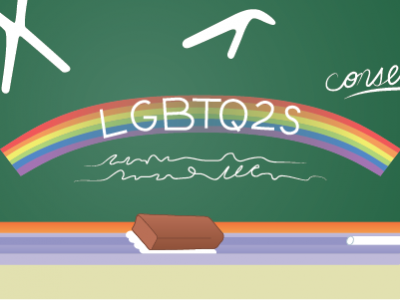
WRTN/SPKN is a story writing and story telling project that took place at the Triangle Program with a group of LGBTQ high school students in grades 9, 10, 11, and 12. For several weeks, we explored creative writing (particularly memoir) through practices including free association, “cut-up,” word strings, found poetry, and collaborative writing. We experimented with voice and form, and the relationship between the written and spoken, and visually explored word. Throughout our creative process, students were encouraged to claim their place as storytellers and experts in their own experience. I provided guidance for the work being produced, but students’ areas of interest (themes and motifs) led the project. Our work together culminated in the production and presentation of individual zines.
Student-creators gave me permission to photograph their work, and develop a video that anthologizes their zines. Together, we viewed the video and talked about what they’d like to see happen with it.
There was consensus amongst the students that the video should be posted and distributed online, and available to everyone as an educational tool. Triangle students particularly want to reach out to other youth who have been or are being bullied at school— and those who can make a big difference: school boards and trustees, school administrators, educators, and guidance counselors.
Many students said that if it weren’t for the Triangle Program, they wouldn’t be in school. Triangle students recognize education as a right for all students, and that safety, or lack thereof, reduces access to education for LGBTQ students, and many other students for a broad variety of systemic reasons. Triangle students would like their stories and creative work to be a beacon for all youth who are struggling with safety and acceptance.
What is a zine? A zine is usually a non-commercial, non-professional publication, kind of like a magazine but with a twist. The main difference between a magazine and a zine is that zines are not out there to make a profit but, rather, to add other, often unheard voices into the mix. Zines are usually made out of interest and passion and are often self-published by the writer/artist/creator. From [http://artmatters.ca/wp/2008/08/what-is-a-zine/]
The Triangle Program is one of three micro-schools that are part of Toronto District School Board’s OASIS Alternative School. Triangle classroom provides a safe educational environment for LGBTQ-identified youth. As the only LGBTQ-focused TDSB school, the curricula and pedagogical framework include LGBQT history and contemporary concerns including shifting notions and locations of LGBTQ community.
I love Florence + the Machine. I discovered her a little late, some time after “Dog Days are Over” had hit it big in North America. Her voice is incredible and her songwriting is amazing, orchestral, all-encompassing, overwhelming. But maybe I should say I loved Florence – after seeing her latest music video for her latest single from Ceremonials, “No Light, No Light,” I’m just not sure.
With warnings for racism, white and Christian supremacy, here’s the video:
Description: Florence Welch, a thin, light-skinned woman, dreamily reaches for a crystal skull. Interspersed with this footage is a muscular, shirtless, dark-skinned person wearing a purple mask covering their face, sitting on a throne surrounded by candles, then jumping down and scampering on all fours to a Voodoo doll on the floor. There is a children’s choir inside a church singing the choral parts of the song’s chorus. Florence is seen on the edge of a tall building, apparently considering jumping. The dark-skinned person stabs the Voodoo doll and Florence flinches. The dark-skinned person rips off their mask and begins a writhing, flailing dance, revealing that it is a man in full-body blackface. The man continues to dance and stab the Voodoo doll, causing Florence to flinch and eventually fall from the building. As she falls, the scene changes to show her running away from a person in blackface (their outfit is different from the first man’s, but it may be the same person). Florence-on-the-street runs while falling-Florence hurtles toward the ground. The children in the church choir look up toward the stained-glass ceiling and reach their arms up. Florence falls through the stained glass in slow-motion, as light breaks through and she stretches her arms out, Christ-like, landing softly among the children, who bear her across them in her cross position. The man in blackface writhes, clutching his chest as if in pain. It is implied that he’s having a heart attack. Florence is lowered to a resting position and closes her eyes.
The blatant racism in this video is, well, blatant. In point form, some of the issues:
In April I made a short film for a class project exploring my love for moustaches and the pressure I feel to remove my natural facial hair. It was quite possibly one of the most empowering things I have ever done: to pick up a camera, create a narrative, edit film and have my own self-told-story shown on a TV screen.
The Spotlight on Muslim and Arab Women’s Stories features free screenings of six feature-length films and is co-sponsored by various Ryerson University departments and faculties.
Some of the other screenings include:
• Unveiled Views – Muslim Women Artists Speak Out (2009, Director: Alba Sotorra), a documentary that follows five Muslim women artists from Turkey, Bosnia, Pakistan, Afghanistan and Iran as they discuss their aspirations and the rights and status of women in their countries. • Round Trip (2010, Director: Golkou Parhizgar), a documentary inspired by director’s experience of returning to Iran after 11 years of living in the UK and rediscovering relationships of those left behind. All of the films are being screened at Toronto’s Carlton Cinemas (20 Carlton St.).
One of the best things about the Spotlight on Muslim and Arab Women’s Stories is that all of the film screenings are free. All you have to do is e-mail info@diasporafilmfest.com to reserve a seat. Click here for a complete schedule.
To kick-start the festivities, there’s a free film event at Carleton Cinemas on Thursday starting at 5 p.m., featuring a screening of the film Forget Baghdad, a documentary following four Iraqi Jews living in exile in Israel who negotiate between their Arab and Jewish cultures. The screening is followed by a talk by academic Dr. Ella Shohat, from New York University.
To say I’m excited to be a part of this roster of amazing films and women directors is an understatement. My short film is being screened twice, once on Friday at 9 p.m. before the documentary Les Secrets and on Sunday at 6 p.m. before the documentary Round Trip .
Check out this preview of Unveiled Views – Muslim Women Artists Speak Out:
Parkdale Library (basement auditorium) 1303 Queen Street West, Toronto Tuesdays from 5:30 to 7:30 p.m. Starts October 11th 2011 and runs until July 1, 2012 – please register!
FINE PRINT
Participants must be 16-29 years old. Workshops are free, but please register by getting in touch (sometimes we fill up)! All supplies and snacks are provided for participants. TTC tickets available for people who need them and live outside the neighbourhood.
Contact Emily Pohl-Weary (coordinator) to register and get more information: info@parkdalewriters.ca or 416-779-1448
(Sponsored by the Canada Council for the Arts, Ontario Arts Council, Toronto Arts Council, Diaspora Dialogues and the Toronto Public Library.)
Hoopla, by the co-author of 2009’s bestselling Yarn Bombing: The Art of Crochet & Knit Graffiti, showcases those who take the craft of embroidery where it’s never gone before, in an astonishing, full-colour display of embroidered art. Hoopla rebels against the quaint and familiar embroidery motifs of flowers and swashes, and focuses instead on innovative stitch artists who specialize in unusual, guerrilla-style patterns such as needlepoint nipple doilies and a ransom note pillow; it demonstrates that modern embroidery artists are as sharp as the needles with which they work. - Arsenal Pulp Press
(Arsenal)
Leanne Prain, author of Hoopla: The Art of Unexpected Embroidery, took some time out from preparing for her Toronto launch/”stitch n’ bitch” (Tuesday, September 27 at 7pm at Type Books, 883 Queen St. West) to answer a few questions for Shameless about her book and subversive crafting.
Shameless: Can you explain what the subtitle of your book, “The Art of Unexpected Embroidery,” means for those who have never heard of this before?
Mouths agape, my co-worker and I took in the sight of a woman dressed as the slave version of Princess Leia (from Star Wars). We were managing a booth at Toronto’s recent FanExpo, and were amazed at the substantial amount of leg on display.
I wouldn’t consider myself a prude, but the abundant partial nudity at FanExpo took some getting used to (it was my first time at a fan convention). Once I adjusted, I began to see the costumes as what they were: another instance of the camaraderie that I found so enjoyable about FanExpo. Troupes of men and women passed by, enthusiastically chatting with us and each other about our fan-related obsessions.
Often they were dressed to the hilt as anime or video game characters in stunningly creative costumes. It was amazing to see the unadulterated enthusiasm of these fans. Irony, something that frequently colours my quasi-hipster existence, was nowhere to be seen. I didn’t miss it in the slightest. And yet, these costumes, worn by women of all ages, were definitely very revealing. The street clothes worn by non-cosplayers seemed to run along the same lines.
I take no issue with wearing revealing clothing, which for many women is an expression of confidence and a celebration of physical beauty, whatever its form. However, I suggest it can be problematic in a place like FanExpo that is populated by a large number of older men, and who appear to be free in taking photos of these girls and women. Alarm bells went off in my head. Surely these men weren’t just moved by the creativity of their costumes.
It’s no secret that Shameless loves the printed word. In an increasingly technological world, books still play a crucial role in our lives as they can present complex issues in a concise form. Books entertain, delight, challenge and educate. They make us think, debate and share ideas. Most importantly they spark discussions. We’re all avid readers, so we’re excited to present the Shameless Book Club podcast. Meeting once a month, Shameless editors and friends discuss and review a book of our choosing.
We’re proud to present “Feminism For Real: Deconstructing the academic industrial complex of feminism,” edited by Jessica Yee as the first book in our book club. Yee, a self-described “Two Spirit multi-racial Indigenous hip hop feminist reproductive justice freedom fighter” and founder of the Native Youth Sexual Health Network, compiled this anthology of essays as it tackles “truth-telling” about some uncomfortable truths in feminism and academia. Confronting the uncomfortable is what makes FFR so powerful because sometimes you have to ask what is going on FOR REAL.
For those of you who are in Toronto, you can grab a copy of “Feminism For Real” at The Women’s Bookstore. You can also order the book here.
If you would like to participate in the discussion or have any questions or book suggestions, get in touch or leave us a comment.
Happy reading and stay tuned for the podcast where we be discussing “Feminism For Real.”